For my final year composition class at the University of Birmingham I was tasked with rewriting the music for the trailer to Oppenheimer. I wrote this in “Logic Pro”, using a mixture of Kontakt instruments, and the “Vital synth” engine. I’ve finally decided to share it here.
All the rights to the visuals fall Universal Pictures as the original rights holders.
Rescored Trailer#
For a comparison here’s the original trailer:
Original Trailer#
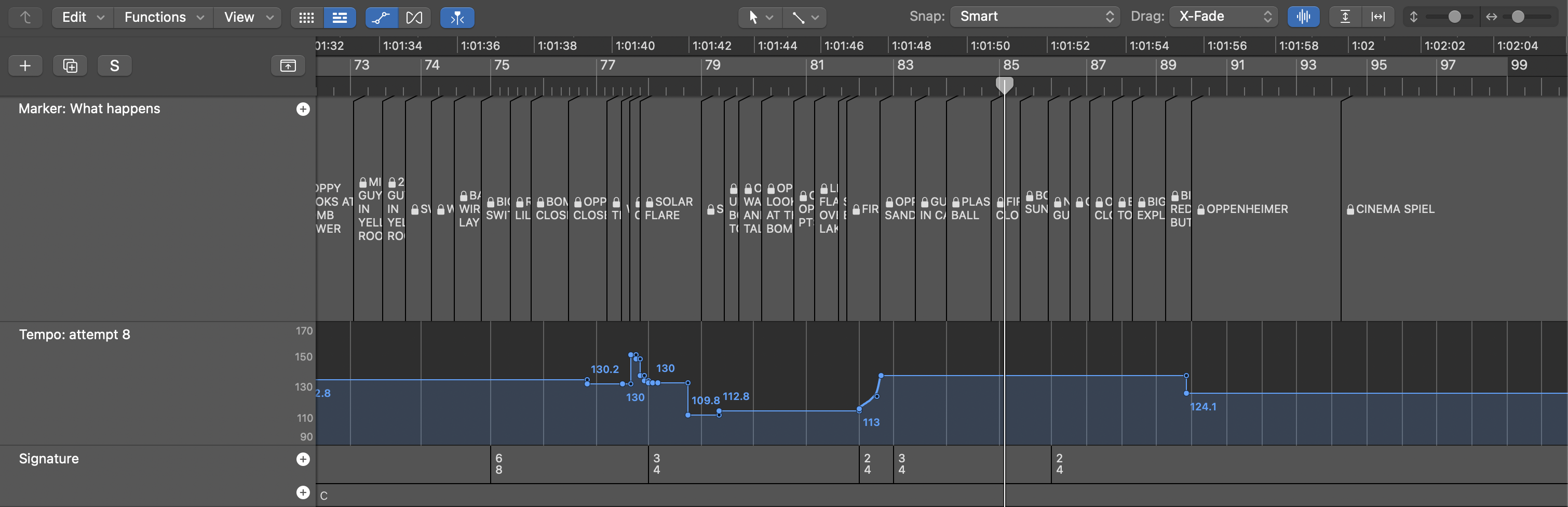
I began my scoring for the trailer by creating a tempo map. I marked out scene transitions using a marker track, making sure to lock the SMPTE time of the markers. I then adjusted the tempo so that scene transitions predominantly aligned with beats. There were quite a lot of changes to the time signature required to remove or add beats where that helped reduce large shifts in tempo, as I aimed to avoid variations greater than 30bpm over the course of the piece.
The piece is scored for hybrid-orchestra (or traditional orchestra and synthesizer, with a lot of SFX and synth pads used throughout), reflecting the thematic material of Robert Oppenheimer pushing technology to its limits to bring us into the nuclear age. I used a deep Pharlight synth whenever the bomb was on screen (beginning at 0:37) to create an uneasy atmosphere, reflecting the dark history of nuclear weapons.
The second half of the trailer uses a metronomic drumbeat to symbolize the driving force behind technological advancement, and the incessant countdown to the first nuclear test. The piece is structured in three distinct sections, building in intensity throughout its duration. It opens with sparce strings, which grow with the addition of basses, and celli. The brass join alongside the lower strings, with a rising melody consisting of long held notes.
Key scene transitions are highlighted with a high-pitched ping created using a highly processed piano patch, alongside a lot of reverb. The ping anticipates the percussion, and helps to create an airy atmosphere, similar to the beginning of Sebastian Haas’ Last Days of Earth (Last Days of Earth, published by Immediate Music). With the first percussion hit of the piece at 0:28 the brass crescendos to a mini climax as the trailer shows a wall of fire. The percussion begins to gain momentum with the transition to a drone shot of the desert at 0:32. I used a combination of Armageddon drums, Action Strikes, and Ferrum drum patches combined with delays and reverbs to give different sounds and rhythms to the drums throughout the piece. I experimented with lining up percussive hits with the trailer beats, like at 0:43 where the percussion lines up with each collision of a fireball, ending in a larger hit coinciding with the fire cloud. The percussion hits serve as a transition at 0:45 to a driving synth rhythm which makes use of an arpeggiator, serving as the backdrop to a clearer melodic line on a haunting Ashlight synth patch. This melody builds towards the climax at 1:19, where the main melodic motif for the piece is heard, consisting of falling sixths, similar to Göransson’s original violin melody for the trailer. Following the sixths is a descending scale with the brass and strings crescendoing towards the title card. Flutes are introduced here as well, to support the upper strings, and basses are reintroduced.
With the climax I aimed to create an expansive orchestration, drawing inspiration from the likes of Gianfranco Pedroli’s United We Stand for the use of a loud, harsh, Vital synth, doubled by brass, and accompanied by a soaring upper string section. 1:41 is composed in a free rhythm so that the explosive hits fit the trailer’s scene transitions, followed byt he reintroduction of the metronomic percussion straight afterwards, to bring the trailer to a close with a series of percussive fills, and a massive hit directly on the title card.
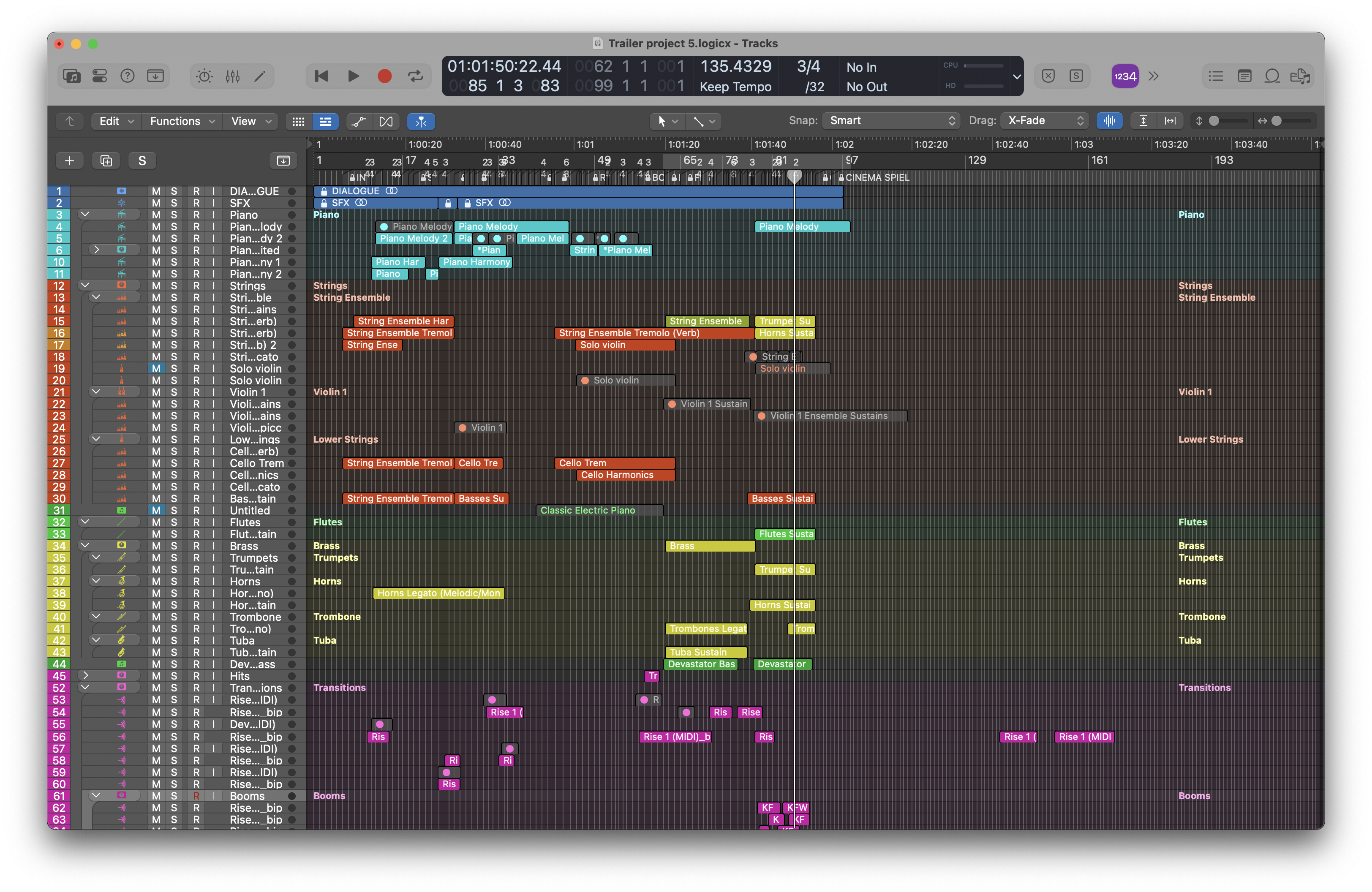
My goal with this composition was to match the atmosphereric tension of the trailer, while also building in intensity, through layering instruments, and increasing the complexity of the orchestration as the piece progresses. While the piece does work on its own, it is first and foremost composed with the SFX of the trailer in mind. It’s written in D minor, heavily emphasizing chords I, III, V and VI. Despite this, however, the tonality is quite ambiguous at points, especially in the opening, and the arpeggiated synth sections.
Reply by Email