This is one of my final year composition projects, In Search of Meaning. Inspired by trailer soundtracks it’s designed to build throughout its runtime, with clear cut points making it ideal as a piece of library music. The brief I composed to was literally called Epic Orchestra. The brief was to write a piece of “epic” music for a full orchestra with synth and SFX elements.
Compositional Process#
I began by writing a 16-bar melody and harmonizing it. I then split the harmonisation into various orchestral families such as strings and brass. From there, I decided on a structure.
My piece begins small, with a simple introduction, and builds to a climax at the end, increasing the movement in the strings, and introducing brass at the climax.
I decided to work backwards from the climax, so I started by writing the climax, which I found helped with structuring the piece so that I knew where I was building towards.
Structure#
In Search of Meaning follows a simple structure of six 8 bar sections, which slowly introduce the melody and build up the instrumentation.
It opens with a very quiet synth section which starts instrumentally simple, laying the atmosphere for the introduction to build into the rest of the piece.
This section is followed by the introduction of the piano laying out the harmony in block chords.
The 3rd section introduces a piano melody over the harmony, accompanied by soft harmonics and tremolo in the strings, which build in intensity into the 4th section.
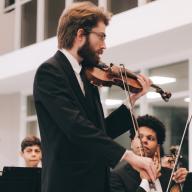
In the 4th section I recorded a violin melody, loosely based off of the piano melody heard in section 3. In this section the strings begin to move more than previously, with descending arpeggios in the upper strings slowly building, while the lower strings take over from the piano by outlining the harmony again. I mirror the strings arrangement in the synths, with an atmospheric pad doubling the upper string arpeggios to give them more space, and the lower synths doubling the lower strings, bringing out the bass frequencies.
I found recording the violin melody gave a lot more life to it than I would have been able to achieve with just MIDI, and really helps sell the illusion of this being a real orchestra.
The 5th section serves to develop the music, emphasizing the lower strings as they play a B section to the violin melody heard in the 4th section. The piano is reintroduced with block chords again, calling back to the opening, and a reversed celeste sample adds atmosphere by doubling the upper strings’ descending arpeggios.
A timpani roll transitions this section into a bridge consisting of a simple bass drum hit and decay, leading into the climax, separating the first 5 sections from the climax of the piece. I found the simple nature of the bridge helps with structuring the piece, having a clearly defined beginning, climax and ending. It also helps as a good cut point, allowing editors to use only part of the piece if they wanted to, making it more versatile if it were to be used in a trailer/TV show.
The climax reuses the melody and harmony from sections 4 and 5, expanding the instrumentation to the rest of a traditional orchestra with the introduction of climactic brass, flutes, and an emphatic drum line. The strings are much more articulate here replacing harmonic and tremolo patches with forceful sustained and spiccato patches. The horns and trombones take the melody for the first half of the climax, building towards the second half where trumpets and tubas join them. The horns consist of a simplified version of the main melody, with less movement, serving as a basis for the flutes and solo violin to double. The tubas outline the harmony along with the trombones, while the trumpets double the horns in the 2nd half. The drums/percussion build throughout the climax, introducing more layers to grow as big as possible.
I finish the piece with a fake out ending, where I reintroduce the piano melody from the start accompanied by harmonic strings after the climax has ended, which appears to be a fairly common way of ending pieces in library music.
graph TB
A("Section 1: Synths") --> B("Section 2: Piano Chords") --> C("Section 3: Piano Melody") --> D("Section 4: Violin Melody") --> E("Section 5: Development") --> F(("Bridge")) --> G{"Section 6: Climax"} --> H(("Fake Out Ending"))
My goal with this piece was to create a piece of music that starts simple and small, and grows to a larger-than-life sound. I didn’t create it with a particular genre of show or movie in mind, however I think it would fit quite well with a drama of some sort, with its modal harmony giving an atmosphere of uncertainty, or perhaps hopefulness.
Reply by Email